You’ve worn bad sandals. We all have. Here’s how to never make that mistake again.
There’s a particular kind of betrayal that only sandal wearers understand. You slide into a gorgeous pair, step out into the world feeling invincible, and by noon your feet are staging a full-blown revolt. Blisters. Arch ache. That mysterious soreness between the toes that has no polite name.
The truth is, most sandals are designed to look good in photographs. Very few are actually engineered for your feet. Whether you’re hunting for the ideal sandals for men and women, refreshing your summer wardrobe, or investing in reliable travel footwear, knowing what separates a comfort-built sandal from a decorative one is genuinely useful knowledge.
Let’s break it down.
Sign 1: The Footbed Has an Opinion About Your Arch
A flat footbed is not neutral. It’s a choice, and it’s usually the wrong one.
A sandal built for real comfort contours to the natural shape of the human foot, which is not flat. Look for footbeds that include a defined arch support, a deep heel cup, and a toe bar. These three elements work together to distribute your body weight evenly across the foot rather than dumping all of it onto your heel and ball.
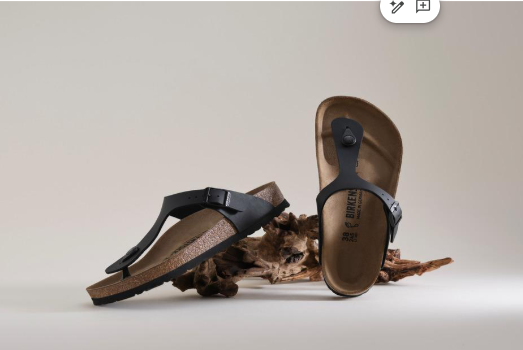
Cork-and-latex footbeds are particularly worth seeking out. They compress and mould to the individual shape of your foot over time, becoming almost custom in fit. This is precisely why styles like the Arizona, Madrid, Mayari and Gizeh by Birkenstock have become shorthand for comfort in the sandal world. The contoured footbed isn’t a feature tacked on as an afterthought. It’s the entire architecture of the shoe.
Sign 2: The Straps Adjust. Properly.
Here is an uncomfortable truth about sandal sizing: your left foot and your right foot are almost certainly not the same size. Add to that the fact that feet swell throughout the day, especially in warm weather, and you begin to understand why rigid, non-adjustable straps are a design flaw rather than a style choice.
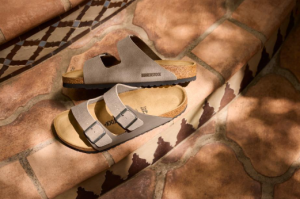
Genuinely comfort-focused sandals for men and women will feature straps with multiple points of adjustment, buckles that don’t dig in, and materials that soften with wear rather than harden against it. Suede linings, nubuck, and natural leather all tend to break in beautifully.
This is equally critical for travel footwear. When you’re navigating cobblestones in Lisbon at 8 am or a waterfront promenade in the evening, your feet will change throughout the day. Your sandals should be able to change with them.
Look at cross-strap designs as well. Styles like the Birkenstock Gizeh (a toe-post silhouette) and the Mayari (a three-strap wraparound) demonstrate how varied strap architecture can be while still prioritising adjustability and anatomical support.
Sign 3: The Sole Has Actual Grip and Real Thickness

Thin soles transfer every pebble, every hot pavement slab, every uneven surface directly to your foot.
A comfort-built sandal sole should be thick enough to absorb shock, flexible enough to bend with your natural stride, and grippy enough that you’re not re-enacting a cartoon slip on every wet surface. EVA and rubber composites tend to perform best across these three categories.
For women and men’s black sandals especially, where the aesthetic skews sleek and the sole is often minimal to match, it’s worth turning the sandal over before buying. If the tread pattern looks purely decorative, trust your instincts.
Sole thickness also matters enormously as travel footwear. Airport terminals alone are the equivalent of several kilometres of walking. A sandal with a well-cushioned, durable sole is the difference between arriving at your destination feeling human and arriving feeling like you’ve been on your feet for a fortnight.
The Bottom Line
A great sandal earns your trust slowly, through contoured support, adaptable fit, and a sole that takes the hit so your feet don’t have to. Whether you’re after sandals for men and women or a pair of men’s black sandals that goes with every outfit in your wardrobe, these three signs are your cheat sheet.